
Software development rarely follows a fixed plan. Requirements change, priorities shift and tasks that seemed straightforward at the beginning may need to be reconsidered along the way. For AI agents designed to support software engineers, this creates an important challenge. Generating tasks is useful, but those tasks also need to remain relevant as a project evolves.
This was one of the topics explored at ASE 2026 in Munich, where Razieh Akbari from Universitat Politècnica de Catalunya (UPC) represented HIVEMIND through two contributions. At the Doctoral Symposium, she presented her research on human-centred AI agents for Agile task management. Later, at the Harness4GenUI Workshop, she demonstrated how the outputs of these agents could be presented in a more structured and visual format. Although the presentations addressed different aspects of her research, both concerned how AI agents can better support the people who work with them.
Agile principles should apply to agents too
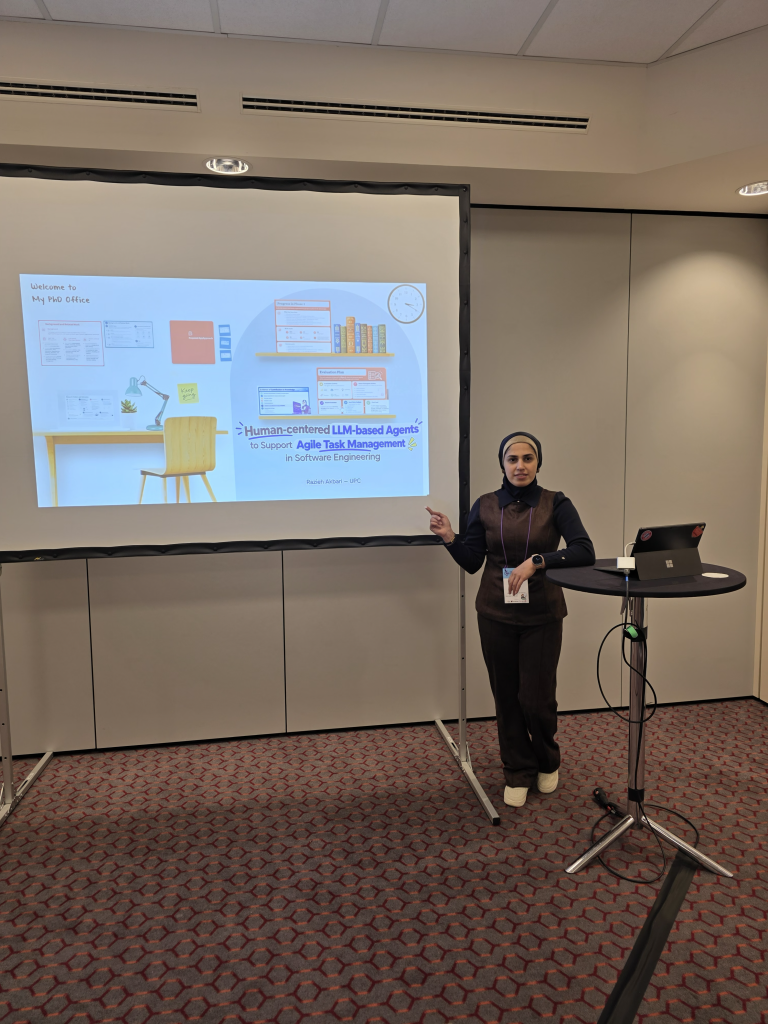
At the Doctoral Symposium, Razieh presented Human-centered LLM-based Agents to Support Agile Task Management in Software Engineering, research closely connected to TaskGenAgent, which she is developing within HIVEMIND.
TaskGenAgent currently follows a single-agent approach, although her broader doctoral research also considers the possibilities of multi-agent systems. Its development focuses on supporting Agile task management, where plans are regularly revised and teams need to respond to changing circumstances.
During the presentation, one question from the audience led to a particularly interesting discussion: Why should Agile principles matter not only when developing AI agents, but also in how those agents operate?
After all, an AI agent can be developed iteratively, with regular improvements based on feedback, without necessarily being able to adapt its own behaviour when project requirements change. The distinction becomes especially important in Agile software development, where task management is rarely a one-off activity. A team might start with a clear set of priorities, only to discover new requirements or encounter unexpected difficulties a few days later. As a result, tasks need to be revised, decisions reconsidered and plans adjusted.
For an AI agent supporting this process, generating an initial list of tasks is therefore only part of the challenge. The more difficult question is how such an agent could respond to new information and human feedback throughout development. The discussion offered Razieh a useful perspective on the future evolution of TaskGenAgent, particularly on how Agile principles could influence not just its development process but also its behaviour.
Moving beyond text-based interactions
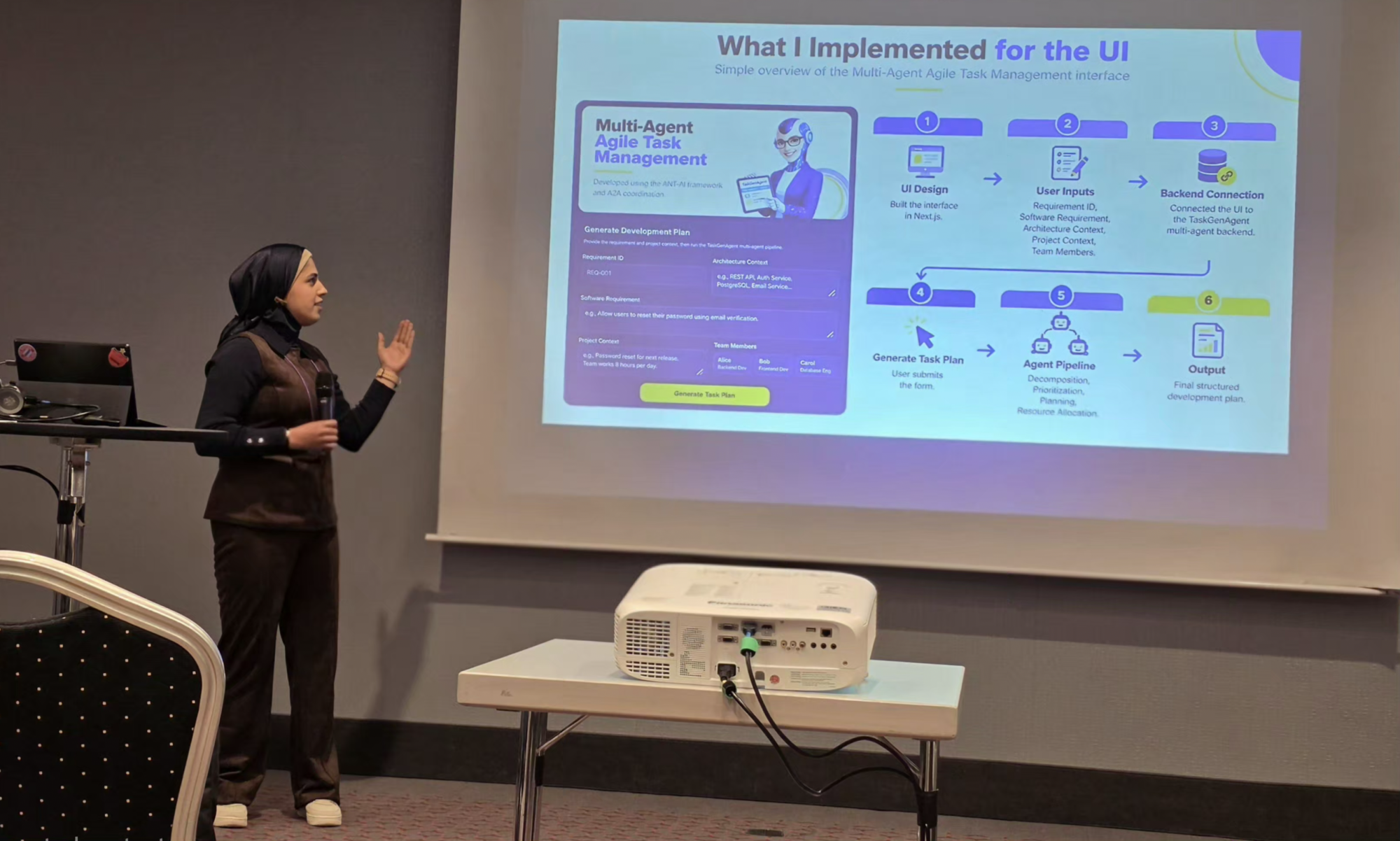
While the Doctoral Symposium focused on how agents operate, Razieh’s second contribution explored how people interact with their results. At the Harness4GenUI Workshop, she presented Generative UI for TaskGenAgent, a technical demonstration of how the information produced by an AI agent could be displayed through a Generative User Interface rather than a conventional text-only response.
AI agents can generate detailed and useful information, yet presenting everything as plain text is not always the most practical option. In task management, for example, a structured visual presentation could make it easier to distinguish between different tasks, understand their relationships and work with the information provided.
To investigate this possibility, Razieh connected Ant AI, the platform used to develop agents within HIVEMIND, with a Generative UI approach from the LangChain ecosystem. The integration was successful and allowed her to present TaskGenAgent outputs through a more structured and visually organised interface. Moreover, the approach did not require generating an entirely different layout every time the agent was executed. Instead, the interface could follow predefined presentation rules while still benefiting from generative capabilities.
This was an important technical result, although Razieh emphasised that the demonstration was not intended to represent a production-ready interface or a formal usability evaluation. Rather, it established that connecting Ant AI with Generative UI is technically feasible and could offer new possibilities for presenting agent-generated information.
Making AI useful beyond the output itself
At first glance, Agile task management and Generative UI may appear to be separate research topics. However, Razieh’s two presentations reveal a common challenge in the development of human-centred AI.
The first concerns how agents respond to the changing circumstances of software development. Even when an agent can generate technically useful tasks, its contribution may be limited if it cannot account for evolving priorities or feedback from the people involved. The second concerns how people receive and use the information generated by agents. An output may contain everything needed to complete a task, but its presentation can influence how easily users understand it and incorporate it into their work.
In both cases, the challenge extends beyond the technical ability to generate a response. It also involves considering the broader workflow in which that response will be used. This becomes particularly relevant as AI agents take on more responsibilities in software engineering. Their usefulness increasingly depends on how well they fit into processes where requirements evolve, decisions are revisited and human judgement continues to play an important role.
What comes next for HIVEMIND
For HIVEMIND, Razieh’s participation in ASE 2026 provided two perspectives on the ongoing development of human-in-the-loop AI for software engineering. The discussion at the Doctoral Symposium raised questions that could inform the future development of TaskGenAgent, particularly how Agile principles might help agents respond more effectively to changing requirements and human feedback. Meanwhile, the Generative UI demonstration established a working technical connection between Ant AI and a different approach to presenting agent outputs. Although incorporating Generative UI is not currently a confirmed development priority for HIVEMIND, the experience could prove useful if similar capabilities are considered in the future.
Both contributions reflect ongoing research rather than finished solutions. Nevertheless, they point towards a broader consideration for AI-assisted software engineering. As agents become more capable, improving what they can generate is only part of the work. Equally important is understanding how they can adapt to the people who use them and how their results can become a practical part of everyday software development.