
Trustworthiness is now part of almost every serious conversation about AI. Yet the more autonomous and interconnected AI systems become, the less straightforward that word appears.
At ASE 2026 in Munich, Sandra Mitrovic from SUPSI represented HIVEMIND at the first TRUST workshop, where she presented On Resilience in Multi-agent Systems for Software Engineering. The team has also recently published Do Multi-Agent Systems Make Better Software? An Empirical Evaluation of LLM-Based Frameworks for Software Development. Both works are available in the Resources section of our website.
What stood out to Sandra at TRUST was the breadth of the discussion. Regulation and legislation appeared alongside hallucinations, fairness, explainability, fault detection, robustness and resilience. For a first edition of the workshop, that variety was striking, but it also showed how many different questions now sit under the umbrella of trustworthy AI.
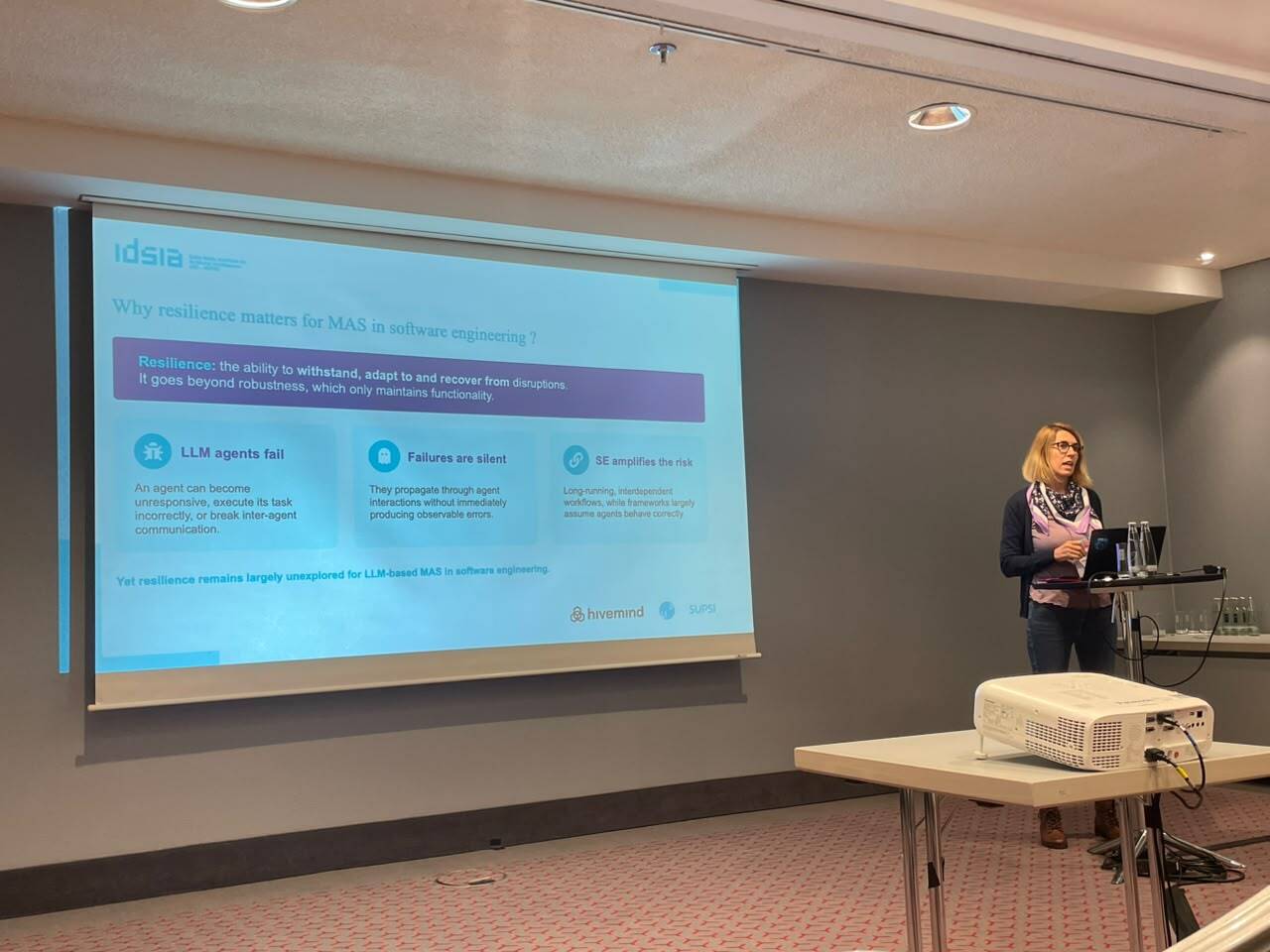
Trustworthiness is still a moving target
The workshop also showed how fragmented the field still remains. Many researchers are working on trustworthiness, but often from within one highly specialised dimension of it.
Sandra’s own presentation focused on resilience, yet the discussion that followed quickly moved beyond the paper itself. Participants asked how ideas such as resilience could eventually be translated into concrete metrics, how much adaptation in a multi-agent system should happen automatically, and where the boundaries of agent autonomy should sit when human involvement remains important.
These questions are difficult precisely because trustworthiness is not one property that can simply be switched on. A system may perform well and still struggle to explain failures, recover from them or recognise when human intervention is needed.
When agents depend on one another
The framework presented by SUPSI looks at resilience through six capabilities: verification, diagnosis, recovery, adaptation, anticipation and withstanding. Applying this framework to eight LLM-based multi-agent systems for software engineering revealed that support for resilience remains limited and fragmented. In particular, diagnosis is largely absent, while anticipation remains only partially developed, limiting higher-level capabilities such as adaptation and withstanding.
The analysis also points to another gap. Existing resilience mechanisms tend to focus more on the quality of generated artefacts than on the resilience of the multi-agent system itself. This distinction matters as multi-agent systems become more complex. Detecting a poor result is one thing. Understanding what went wrong, recovering from it and deciding whether the system should adapt its behaviour afterwards is another.
From specialised studies to shared benchmarks
Towards the end of the workshop, the discussion widened again. The organisers raised the possibility of developing shared benchmarks for trustworthy AI instead of relying on separate approaches for every individual domain.
The idea prompted a lively discussion, but also exposed how difficult such a task would be. Trustworthiness covers very different dimensions, and even resilience still raises basic questions about how its different capabilities should be translated into measurable indicators. Moving from broad principles to practical evaluation therefore remains an open challenge, especially as agentic AI moves closer to real software development workflows.
Trust also changes the people around the system
One of the studies discussed at TRUST approached the issue from a different angle by looking at how LLMs affect project managers. The point stayed with Sandra because it shows that trust is not only a question of system behaviour. As AI becomes more involved in producing work, managers may have less visibility into what came from an employee, what was generated by AI and how much confidence they should place in either.
At the same time, managers may adopt these tools more slowly themselves, leaving them to supervise workflows that are changing faster than their own role. This is another reminder that trustworthy AI is not only about models, agents or technical safeguards. It also changes responsibilities, expectations and the way people evaluate work.
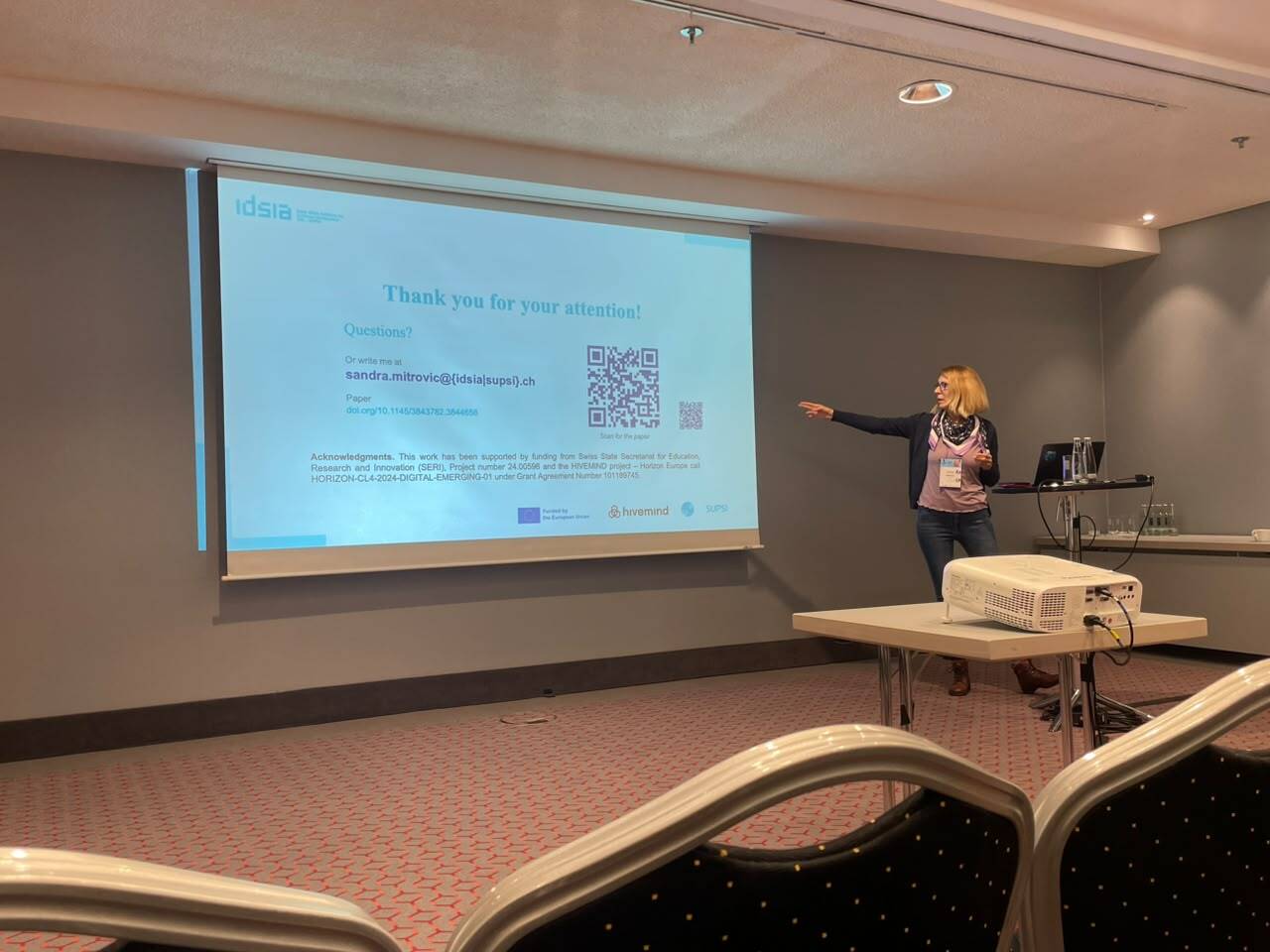
From broad principles to something we can test
For HIVEMIND, these discussions are directly relevant. The project is developing a multi-agent environment for software engineering, which means trust cannot be treated as a separate layer added at the end. It has to be considered in how agents collaborate, how failures are handled, how much autonomy they receive and where human judgement remains necessary.
The TRUST workshop showed that the field is already asking these questions from many different directions. The next challenge is to move from broad ideas such as trustworthiness towards approaches that can be observed, evaluated and tested in practice.